

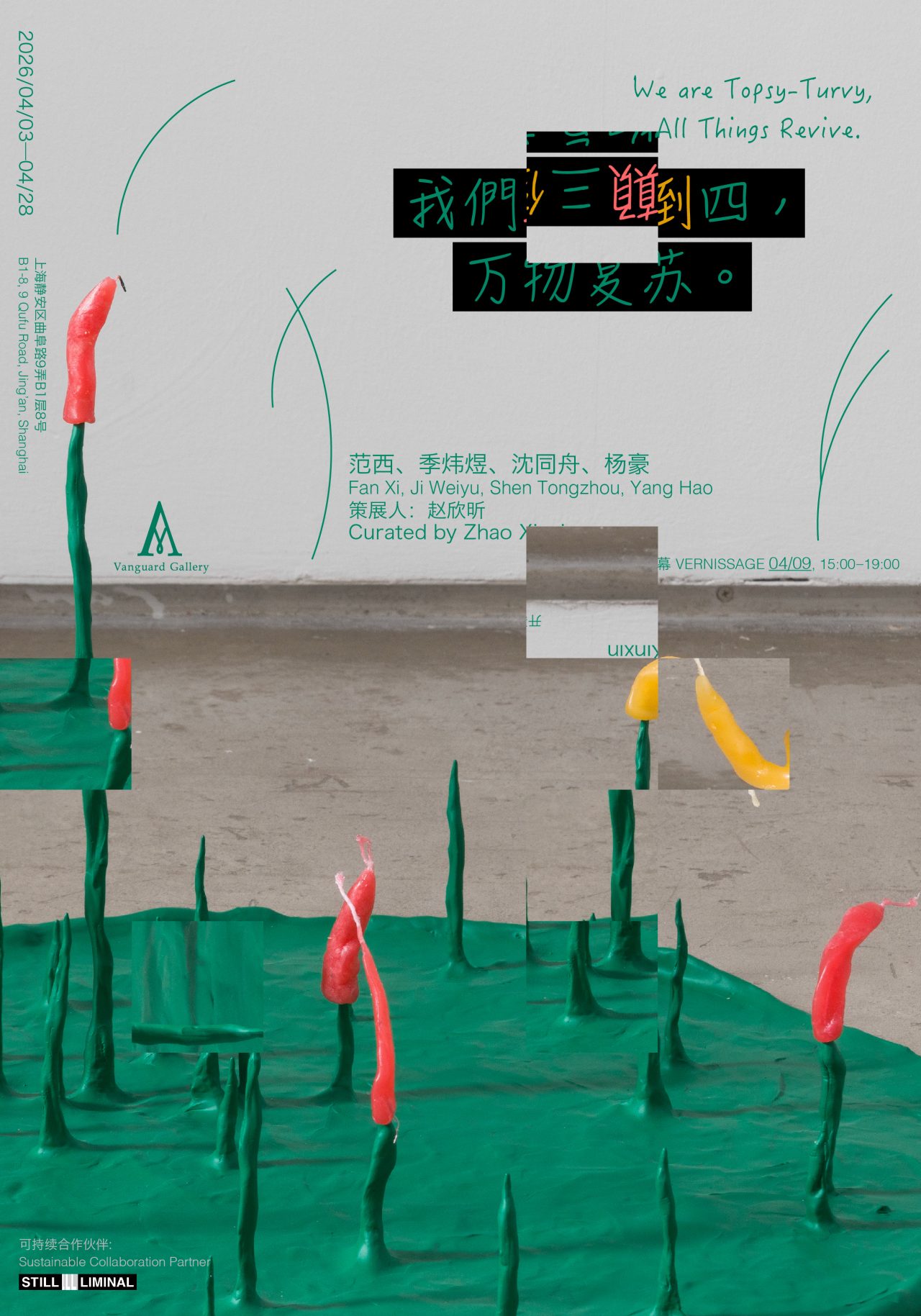
Vanguard Gallery is pleased to present “We Are Topsy-Turvy, All Things Revive,” a spring group exhibition focusing on the recent practices of Fan Xi, Ji Weiyu, Shen Tongzhou, and Yang Hao.
Another year turns. The ground thaws, and life reawakens from fatigue, dullness, and weight. This is not a spectacular moment, it is closer to a slow loosening: structures falter, boundaries soften, and things begin to slip, ever so slightly, out of place. News and old news alike leave us disoriented. We stand, dazed, in the suddenly warming air. Order keeps updating, meaning fractures as it forms—at every second, new forms of intelligence emerge, and the world trembles as it draws out its first shoots. Body and consciousness, misaligned and inverted, grope and sense their way forward. A low, humming, almost gentle disorder.
In Yang Hao’s paintings, the restless pulse of carbon-based life feels, unexpectedly, reassuring. He conjures a vivid world suspended between daydream and reality: speeding taxis, drunken vomiting, a fish that deliberately swims into a net, green fingernails… These images echo one another while refusing to cohere. Cars, boats, mirrors, and toilets become temporary docking points for the “self,” while drawers open as cross-sections of consciousness, holding fragments of dreams and desire.
Ji Weiyu’s practice unfolds through a certain pleasure in division and regeneration. Beginning with photography, his images lose their original visual structure and mnemonic ties. They are cut into discrete units and set into new relations, where they grow organically, like skin. In Image Field :The Gatekeeper, lacquer brings a further shift: the blurred face of an ancient sculpture emerges through repeated scraping and printing, acquiring a subdued, enigmatic sheen. The image no longer points outward. It becomes instead a system in transformation, shedding and re-forming between structure and material.
If Ji’s images still retain a surface coherence, a newly assembled order, Fan Xi moves further toward transformation. Faces and pages overlap like fleeting fragments of inner scenery, only to fall apart in the next instant. Working with a gardener’s logic of grafting and propagation, she handles wax and photographic paper: materials are joined with care, cut at certain points, and quietly continued elsewhere. The candle’s capacity to melt entangles time in the process of formation. Matter shifts, wanes, and gathers. What appears to be loss persists stubbornly in another form.
This state of topsy-turviness finds yet another circuit in Shen Tongzhou’s work. The network is not an exit, but an interface in continuous operation, disassembling and relaying reality. Experience is copied, delayed, replaced—compressed into transmissible fragments, only to return in altered forms. The virtual and the real no longer stand apart. They permeate one another, as if differing only in density.
Across these practices, no clear boundary holds. Each, in its own way, loosens the authority of structure and lets process come to the surface: the drifting of consciousness, the reworking of images, acts of grafting and transformation, the crossing of information. Disorder, perhaps, marks a necessary deviation—a recalibration of perception. Things slip from their assigned order, entering zones yet to be named. What emerges from these seemingly scattered gestures is a quiet alignment: we are not facing a stable, fully formed world, but one still in the act of opening—like a drawer being drawn open.
Text: Zhao Xinxin
Installation View


Artworks

YANG Hao
Drive to nowhere
40 × 40 cm
2025

YANG Hao
I throw up a lot on Sunday night
67 x 67 cm
2025

YANG Hao
Farewell at sea
50 × 50 cm
2025

YANG Hao
Mahlzeit
67 × 62 cm
2023

YANG Hao
U are not in the mirror
38 × 34 × 16 cm
2025

JI Weiyu
Early Spring Landscape of Maqiao
150 × 440 × 1.5 cm
2025

JI Weiyu
The Gatekeeper non one
200 × 135 cm
2026
-1280x958.png)
JI Weiyu
Z2nd
15 × 22.5 cm * 1
22.5 x 15 cm * 3
2025

Z2nd
15 × 22.5 cm * 2
22.5 × 17.5 cm * 1
2025

JI Weiyu
Z2nd
22.5 x 15 cm * 4
15 × 22.5 cm * 1
2025

FAN Xi
Pause
30 × 56 cm
2024

FAN Xi
Landscape
25 × 18 cm
Framed: 35 × 26.5 cm
2023

FAN Xi
2011
50 × 36 cm
2025
》-2-web-1280x854.jpg)
FAN Xi
Silent (1)
24.5 × 25 × 1 cm
2025
》-2-web-1280x1590.jpg)
FAN Xi
Silent (5)
67.5 × 67.5 × 7 cm
2025

FAN Xi
Solo
Overall: 31 × 23 × 27 cm
Base: Ø33 × 3 cm
2025

FAN Xi
Untitled
150 × 48 × 40 cm
2026
》-web-1280x1920.jpg)
FAN Xi
Untitled (one corner)
30 × 20 × 17 cm
2021

SHEN Tongzhou
Spring Outing
17' 14”
2024

YANG Hao
I’m the captain
50 × 50 cm
2023